

Alberto Mari was one of the great European problemists member of the Good Companions. He was the editor of "L'Alfiere di Re" and of "L'Italia Scacchistica".
Mari, Alberto
Tijdschrift vd NSB, 1929
1st Prize

Tijdschrift vd NSB, 1929
1st Prize
| #2 | 11 + 11 |
Show Solution

Comins Mansfield (14-06-1896 - 28-03-1984) British composer and Grandmaster
 |
| Comins Mansfield in his twenties |
 |
| Comins Mansfield |
Comins Mansfield became International Judge in 1957 and was the first Briton to be awarded the FIDE title of Grandmaster, 4 years before Tony Miles.
He was president of the British Chess Problem Society from 1949 until 1951 and president of the PCCC from 1963 until 1971. He was probably the greatest twomover composer of the 20th century.
"A Genius of the Two-Mover" in Alain C. White's Christmas Series, proposes a selection of 113 problems by Comins Mansfield, with commentary. It can be read here. "Adventures in composition" by C. Mansfield in Alain C. White's Overbrook Series, is an autobiographical treatise on the composition of two-movers, with 110 examples. It can be read here.
Mansfield, Comins
Schiffmann MT, Revista Română de Şah, 1931
1st Prize

Schiffmann MT, Revista Română de Şah, 1931
1st Prize
| #2 | 12 + 8 |
Show Solution
Mansfield, Comins
The British Chess Magazine, 1930
1st Prize

The British Chess Magazine, 1930
1st Prize
| #2 v | 9 + 7 |
Show Solution
Rui de Carvalho Nascimento (14-06-1914 - 03-09-2012) Portuguese composer and Honorary Master
 |
| Rui de Carvalho Nascimento (1978) [Wikipedia] |
Rui de Carvalho Nascimento is the author of "Problemas de Xadrez" (1986) and "Problemas de Xadrez II" (1995). He composed mostly twomovers.
More information about him can be found in Portuguese on Wikipedia and a 2004 photo of him on xadrezpt.com [broken link].
Nascimento, Rui De Carvalho
Stratford Express, 1949
Prize, (Originality)

Stratford Express, 1949
Prize, (Originality)
| #2 | 9 + 9 |
Show Solution
Nicolaas Cortlever (14-06-1915 - 05-04-1995) Dutch composer

Nicolaas Cortlever was o.t.b. IM and the author of some analytical endgame studies.
Cortlever, Nicolaas
Schakend Nederland, 1983 (1950)
4th Honorable Mention

Schakend Nederland, 1983 (1950)
4th Honorable Mention
| + | 6 + 6 |
Show Solution
Wolfgang Dittmann (14-06-1933 - 05-02-2014) German composer and International Master
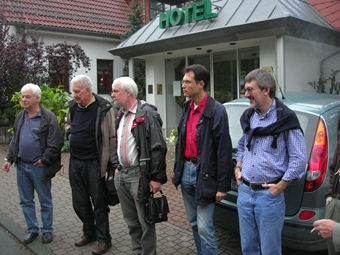 |
| Rainer Paslack, Wolfgang Dittmann, Hartmut Laue, Carsten Ehlers & Arnold Beine, Meerane 2006 [Die Schwalbe] |
Wolfgang Dittmann was also an International Judge in retro problems. He composed direct mates and selfmates but recently started composing only retro problems, especially AntiCirce Proca Retractors, for which he was famous.
His book "Der Blick zurück" (2004) is a reference work for retrograde analysis theory and practice.
Dittmann, Wolfgang
O-O, 1979
1st Prize, ex aequo

O-O, 1979
1st Prize, ex aequo
| Castling in 1 before 4 moves Defence retractor Type Proca | 2 + 7 |
Show Solution
Dittmann, Wolfgang
Die Schwalbe, 1989
1st Prize

Die Schwalbe, 1989
1st Prize
| #5 | b5, f4, d3, e2: Nightrider | 7 + 12 |
Show Solution
Исаак Шулимович Бирбрагер (14-06-1935 - 1993) Russian composer (Isaak Shulimovich Birbrager)
Isaak Birbrager was a strong player, journalist and composer.
Бирбрагер, Исаак Шулимович
Revista Română de Şah, 1959
1st Prize

Revista Română de Şah, 1959
1st Prize
| #2 | 7 + 8 |
Show Solution
Gérard Doukhan (14-06-1954) French composer and FIDE Master
Gérard Doukhan is a twomover composer.
Doukhan, Gerard
Die Schwalbe, Aug 1983 (4386)
1st Prize

Die Schwalbe, Aug 1983 (4386)
1st Prize
| #2 | vvv | 13 + 9 |
Show Solution
Miodrag Mladenović (14-06-1964) Serbian composer and Grandmaster (Миодраг МЛАДЕНОВИЋ)
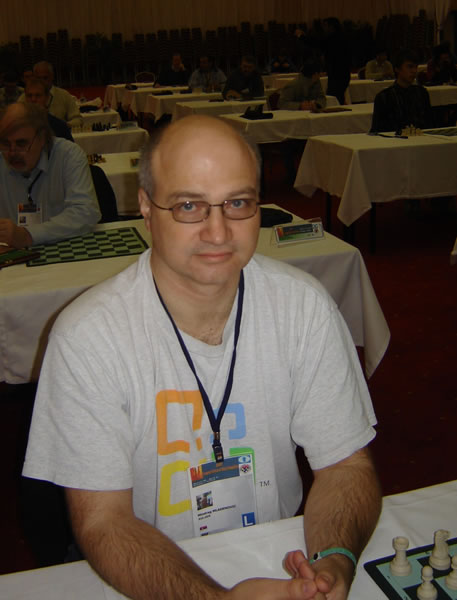 |
| Miodrag Mladenović [Wikipedia] |
Miodrag Mladenović is Grandmaster in composing and solving. He is Slobodan Mladenović's son. More about his problems on the Serbian Problemists website.
He composes mostly directmovers and selfmates. 6 of his best reflexmates have been analyzed by Juraj Lörinc on his website.
Mladenović, Miodrag
Mat Plus, 1997
1st Prize

Mat Plus, 1997
1st Prize
| #3* | 5 + 9 |
Show Solution
Mladenović, Miodrag
The Problemist, 2005
1st Prize

The Problemist, 2005
1st Prize
| #3 | 10 + 12 |
Show Solution
Martin van Essen (14-06-1980) Dutch composer

Martin van Essen is a player, solver and composer. One of his successes was his 2nd prize in the Humor Study tournament 2004 won by Sergiy Didukh - details on Tim Krabbé's diary.
Van Essen, Martin
Avni-JT50, 2005
1st Prize

Avni-JT50, 2005
1st Prize
| = | 6 + 9 |
Show Solution
Dieter Kutzborski (14-06-1947 - 27-04-2019) German composer
 |
| Dieter Kutzborski in 1968 [SSZ 1968, page 132] |
Marcel Tribowski has been kind enough to attract our attention to this composer. Although Dieter Kutzborski was one of the very best contemporary three- and moremover composers, his work is unfortunately not as well-known as it should be. He refused to submit his problems to FIDE-Albums, which means that he will not be granted a FIDE title for composing and this might explain why his work is somewhat overlooked.
Dieter Kutzborski is the co-author, with Wolfgang Dittmann and Armin Geister, of "Logische Phantasien. Herbert Grasemann und seine Schachaufgaben."
Herbert Grasemann told in "Schach ohne Partner für Könner" how Berlin problemists met Dieter Kutzborski for the first time; this passage was translated into English by Daniel Maxwell and published on ChessProblem.net by Gary Kevin Ware.
Peter Krug has also offered us some words about Dieter in a comment below.
Kutzborski, Dieter
Die Schwalbe, Dec 1969
1st Prize

Die Schwalbe, Dec 1969
1st Prize
| #4 | 10 + 13 |
Show Solution
Kutzborski, Dieter
Schach-Aktiv, 2007
1st Prize

Schach-Aktiv, 2007
1st Prize
| #15 | 9 + 13 |
Show Solution
Slavko Radovanović (14-06-1949 - 18-07-2013) Serbian composer
Slavko Radovanović composed direct mates, helpmates and selfmates.
The Serbian Problemists have quoted a selfmate on this page.
Радовановић, Славко
6th Place
Liga Problemista, 2000 (2)

6th Place
Liga Problemista, 2000 (2)
| h#2 | 4 solutions | 5 + 8 |
Show Solution
Heikki Lukkarinen (14-06-1918 - 18-10-1941) Finnish composer
 |
| Heikki Lukkarinen [Heikki Lukkarinen Shakkitehtävät | Chess Compositions] |
I shall quote the cover of Jorma Paavilainen's book "Heikki Lukkarinen Shakkitehtävät | Chess Compositions" which presents all 132 Lukkarinen's known compositions, with comments in Finnish and English:
Heikki Lukkarinen was a talented composer, who was only 23 years old when he lost his life in WWII. He published his first compositions at the age of fourteen and soon became one of Finland's leading composers.
Lukkarinen, Heikki
Suomen Shakkiliitto, 1934 1st Prize
Helsingin Sanomat, 29 Apr 1934

Suomen Shakkiliitto, 1934 1st Prize
Helsingin Sanomat, 29 Apr 1934
| #2 | 7 + 13 |
Show Solution

This comment has been removed by the author.
ReplyDeleteDieter Kutzborski (1947–2019)
ReplyDeleteThe Architect of Logical Silence
The world of chess composition has lost one of its quietest yet most resonant masters. Dieter Kutzborski, who passed away in Wilhelmshorst on April 27, 2019, was not a man of the grand stage or glittering titles. He did not seek the validation of FIDE albums; instead, he sought absolute logic across the 64 squares.Born in the ruins of post-war Berlin, he discovered his true calling as a young boy in a hospital bed through the works of Kraemer and Zepler. What began as a solitary pastime blossomed into a lifelong passion for the "New German School" of composition.
A Legacy of Juridical Precision and Poetic Depth
A lawyer by profession, Kutzborski understood the essence of cause and effect. He translated this clarity directly into his art. His three-movers and more-movers are not mere puzzles; they are miniature dramas of light and shadow. With surgical precision, he constructed logical maneuvers where every piece served an indispensable purpose—often revealed to the solver only at the very last moment.
A Master Without Titles—By Conviction
It is a testament to his character that he refused to submit his work for official FIDE titles throughout his life. He was never interested in the prefix of "Grandmaster"; he cared only for the aesthetics of the "encrypted stone." In a world that often demands visibility, he was a guardian of the essential.His Enduring WorkThrough his creations, he showed us that true mastery needs no certificates to endure. His problems will continue to captivate generations of solvers through their strategic richness, their elegance, and a profound respect for the beauty of chess.
We bow our heads in honor of a great Berlin problemist who taught us that the quietest moves often carry the greatest weight.