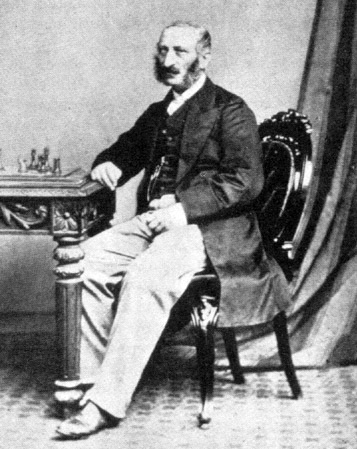
Marcel Duchamp (28-07-1887 - 02-10-1968) French-American composer
 |
Marcel Duchamp playing chess, by Kay Bell Reynal
[Wikipedia] |
Marcel Duchamp is considered as a very notable artist of the 20th century. His peculiarity, beyond his unconventional thought and subversive actions, was that he was so infatuated with the game of chess that he almost completely excluded artistic activities. His chess games can be played on
chessgames.com.
One of his most famous quote about the subject, and the more relevant for chess composers, is the following:
"The chess pieces are the block alphabet which shapes thoughts; and these thoughts, although making a visual design on the chess-board, express their beauty abstractly, like a poem. ... I have come to the personal conclusion that while all artists are not chess players, all chess players are artists."
In 1932, Duchamp and Vitaly Halberstadt to publish "
L'opposition et cases conjuguées sont réconciliées" (Opposition and corresponding squares are reconciled).
You can see on
Ubu "
A Chess Sonata in 8 Movements" by Jean Cocteau, Marcel Duchamp and Hans Richter and Duchamp's dada film "
Anemic Cinema" (1926).
Here more to understand Duchamp's works.
Duchamp, Marcel
Through the Big End of the Opera Glass, Dec 1943

| White to play...[ What is the result? ] | | 4 + 4 |
Show SolutionWhite to Play and Win was Duchamp's original (teasing?) stipulation. Although the result is still inconclusive, the position appears to be a draw.
1.Ke4 h4 2.Kd5 h3 3.Kc6 h2 4.Rg7+ Kf2 5.Rh7 Kg2 6.Kc7 Rg8 7.b8/Q Rxb8 8.Kxb8 h1/Q 9.Rxh1 Kxh1 10.b6 f5 11.b7 f4 12.Kc7 f3 13.b8/Q f2 =
1.Ke3 h4 2.Rg7+ Kf1 3.Kf3 Ke1 4.b6 h3 5.Rh7 f5 =