Saturday, July 14, 2012

July 15th

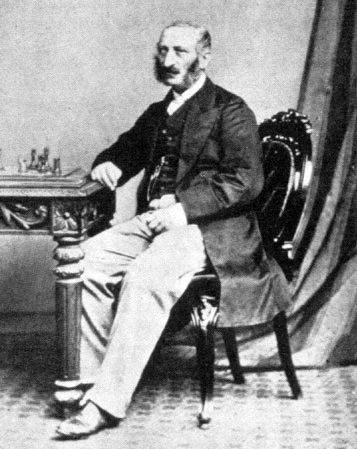
János Jakab Löwenthal (15-07-1810 - 20-07-1876) Hungarian - British composer

János Jakab Löwenthal
[Wikipedia]

János Jakab Löwenthal was an excellent chess player who played against Morphy in two matches and wrote the compilation "Morphy's Games of Chess". He also occasionally composed some trifles such as this one:

Löwenthal, János Jakab
The Chess Player's Chronicle, 1851


#3 6 + 5

Show Solution

Friday, July 13, 2012

July 14th

Сергей Иванович Пименов (14-07-1907 - 1981) Russian composer (Sergey Ivanovich Pimenov)


Sergey Pimenov
[Thanks to Александр Никитин]


Sergey Pimenov was a twomover composer.

Пименов, Сергей Иванович & Пименов, Виталий Иванович
Труд (Москва) 1935
3rd Prize


#2 11 + 9

Show Solution

Thursday, July 12, 2012

July 13th

Ionel Razu (13-07-1908) Romanian composer

Ionel Razu composed mostly direct mates.

Razu, Ionel
Revista Română de Şah, 1984
2nd Prize


#2 12 + 7

Show Solution

Wednesday, July 11, 2012

July 12th

Percival Guy Laugharne Fothergill (12-07-1868 - 29-06-1948) British composer

Not much can be said about Percival Fothergill, except that he bears the name of a superhero and he composed direct mates.

Fothergill, Percival Guy Laugharne
Hackney Mercury, 1893
1st Prize


#2 12 + 5

Show Solution

Tuesday, July 10, 2012

July 11th

Santi Pirrone (11-07-1920 - 12-06-2006) Italian composer


Santi Pirrone was just a solver when he was encouraged to compose by his friend composer Umberto Castellari.

Pirrone, Santi
L'Italia Scacchistica, 1966
1st Prize


#2 vvv 10 + 5

Show Solution

Monday, July 9, 2012

July 10th

Otto B. Wurzburg (10-07-1875 - 19-10-1951) American composer

Otto Wurzburg
[Valery Surkov [broken link] ]


Otto Wurzburg was the nephew of W.A.Shinkman. He composed more than 1200 problems in 3 or more moves. He gave his name to a form of the Plachutta theme, the Wurzburg-Plachutta, whose definition was explained by Emmanuel Manolas on his blog.
Edgar Holladay compiled 200 of his problems in "Wurzburg Artistry" (1974) and Valery Surkov proposed many of his problems with their solutions on his website [broken link].

Wurzburg, Otto B.
Norwich Mercury, 8th Apr 1913


#4 9 + 11

Show Solution
Wurzburg, Otto B.
The Pittsburgh Gazette Times, 15th Jul 1917
1st Prize


#3 10 + 6

Show Solution

Sunday, July 8, 2012

July 9th

József Szén (09-07-1805 - 13-01-1857) Hungarian composer

József Szén

József Szén was a strong player and his strength deployed itself all the better in the endgame.

He discovered what is now called the Szén position, a defensive drawing position in K+R vs K+R+B endgame. "Szén's position is the most important for over-the-board players. Compared to the Philidor Position, the kings are not opposite each other and the defending rook can prevent checkmate. The position is a draw only if there is enough room for the defending king on the side with the rooks" (Wikipedia).


More info about Szén can be found on edochess.ca and on the blog of Impala Publications. James O'Fee quotes "The Oxford Companion to Chess" (1984) by Hooper and Whyld and we can thus learn that József Szén had discovered all the mysteries of the "Three Pawns Problem" (initial position wKd1, Pa2, b2, c2 vs bKe8, Pf7, g7, h7) when he played it against Saint Amand and other French players in 1836. The verdict is that whoever plays first wins, for instance 1 Ke2 Kd7 2 Kf3 Kc6 3 a4 h5 4 c4 f5 5 Kg3 Kb6 6 b4 g5 7 a5+ Ka7 8 c5 h4+ 9 Kh2 Kb8 10 b5 f4 11 Kg2 g4 12 Kg1 g3 13 Kg2 Kb7 14 b6 +- (White sets up the last of four successive zugzwangs after which Black can no longer hold up White's pawns.) 14 ... Kb8 15 a6 Kc8 16 c6 Kb8 17 a7+ Ka8 18 c7  +-
The solution was published in 1838 by G. Walker and the English problemist William Bone.

Here is a conditional problem composed by him:

Szén, József
Le Palamède, 1836


#8 with bK mated on d5 3 + 1

Show Solution