The en passant capture is, together with castling and promotion, one of the three special moves in chess. The special character of the en passant capture is underlined by the fact that the arrival square is not occupied by the captured piece – an effect which can be also met in fairy chess compositions.
In Proca Retractor compositions the main challenge is to find good motivations in order to force Black to retract the en passant capture. This challenging theme can be realized combined with different fairy conditions.
Proca Retractor definition:
A Proca Retractor is a defensive Retractor. Black is defending by trying to retract the moves that will forbid (or delay) the achievement of White's goal. You may see at the Retro Corner an example by W. Dittmann of orthodox Proca Retractor showing two en passant captures.
The first composer who successfully showed the Black and White double en passant capture was Dr. Klaus Wenda. In the first two problems we can see how he managed to present this theme combined with Madrasi and AntiCirce Cheylan.
Showing posts with label Raican. Show all posts
Showing posts with label Raican. Show all posts
Wednesday, December 18, 2013

Saturday, August 25, 2012
August 26th
Сергей Михайлович Каминер (26-08-1908 - 02-11-1938) Russian composer (Sergey Mikhailovich Kaminer)
Sergey Kaminer composed endgame studies (and one helpmate). In 1937 he left a notebook with all his studies to his friend Mikhail Botvinnik, who revealed their existence in the 1950s after Stalin's death.
Rafael Kofman's 1981 book "Izbrannye etjudy" contains Kaminer's 75 studies. And JMRW reproduces 30 of Kaminer's studies on his website.
Show Solution
 |
| Sergey Kaminer [Wikipedia] |
Sergey Kaminer composed endgame studies (and one helpmate). In 1937 he left a notebook with all his studies to his friend Mikhail Botvinnik, who revealed their existence in the 1950s after Stalin's death.
Rafael Kofman's 1981 book "Izbrannye etjudy" contains Kaminer's 75 studies. And JMRW reproduces 30 of Kaminer's studies on his website.
Каминер, Сергей Михайлович
«64» 1935 (679)
2nd Prize
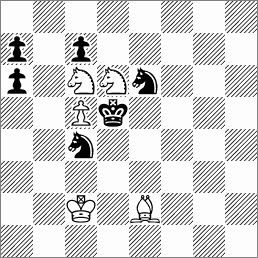
«64» 1935 (679)
2nd Prize
| + | 5 + 6 |
Show Solution
Friday, January 6, 2012
January 6th
Paul Răican (06-01-1957) Romanian composer and editor of French-speaking magazine Quartz.

Show Solution

Răican, Paul
Mat Plus, 2007 (27/781)
Special Prize

Mat Plus, 2007 (27/781)
Special Prize
| #7 | Maximummer KoeKo PWC (Circé échange) b) wKd4-->b5 s#7 | 2 + 2 |
Show Solution
Subscribe to:
Posts (Atom)