 |
| Michael Keller, Martin Wessels and Thorsten Zirkwitz, 2000 [Photo by Günter Büsing] |

[Echesspedia [broken link] ]
Michael Keller is specialized in two- and threemovers.
The Keller paradox is a direct mover theme that requests that "White moves to a square just controlled (or controlled again) by Black."
In 1994 Friedrich Chlubna wrote the collection "Michael Keller. Ein Meister der Schachkomposition" comprising 279 problems by Keller.
On Wikipedia you may see an excellent and strategically very rich threemover of his. Of course Michael Keller composed many beautiful problems, but here is a typical one:
Keller, Michael
Schach-Aktiv, 1999

Schach-Aktiv, 1999
| #3 | 12 + 12 |
Show Solution

Michael Grushko (31-05-1955) Ukrainian-Israeli composer
 |
| Semion Shifrin and Michael Grushko |
Michael Grushko composes in all genres but mostly fairy problems and especially miniatures or Wenigsteiner with neutral pieces and several fairy conditions.
You may read here a short portrait of him made by Leonid Lubashevsky on "Kozatska Shakhivnytsia".
Grushko, Michael
Mat Plus, 2007 (25/642)
2nd Prize

In ChameleonChess, all pieces are Chameleons.Mat Plus, 2007 (25/642)
2nd Prize
| hs#5.5 | ChameleonChess Maximummer ParrainCirce h3, h2: Neutral Pawn b) nPh2->g2 | 1 + + 2 |
Show Solution
Валерий В. Гуров (31-05-1967) Russian composer and Grandmaster (Valery Gurov)
 |
| Andrey Selivanov and Valery Gurov, 2008 [selivanov.world] |
Valery Gurov is a well-known composer, involved in composing, judging and organizing chess problem tourneys. He is the helpmate editor of Uralski Problemist.
He composes mostly helpmates, but also fairy problems. First an example of helpmate:
Гуров, Валерий В.
Buletin Problemistic, 2000

Buletin Problemistic, 2000
| h#2 | 8 + 11 |
Show Solution
And one example of fairy problem:

Show Solution
Сергій Ігорович Дидух (31-05-1976) Ukrainian composer and FIDE Master (Serhiy Igorovich Didukh)
 |
| Sergiy Didukh [akobia] |
Sergiy Didukh is a young talented composer whose endgame studies have already been remarked by judges. He was also noticed for his sense of humour and his articles in varied magazines (Mat Plus) or his column in The Problemist before Yochanan Afek came back.
Some of his studies were reproduced on jmrw.com [broken link] and his current website (and study database) here.
Here the detailed solution of an excellent study of his, presented by Brian Stephenson. Wikipedia also has some information about him and Peter Krug has offered us some words about Serhiy in a comment below.
Дидух, Сергій Ігорович
Humor Tourney EBUR, 2004
1st Prize

Humor Tourney EBUR, 2004
1st Prize
| = | 6 + 11 |
Show Solution
Ugo Lancia (31-05-1885 - 21-07-1960) Italian composer
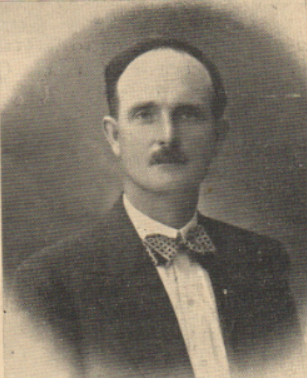 |
| Ugo Lancia [Il Problema] |
Ugo Lancia was a correspondence player, solver and chess composer.
He was a prolific composer and composed mostly two- and three-movers, as well as some helpmates.
More about him on Wikipedia.it.
Lancia, Ugo
L'Italia Scacchistica, 1917
1st Prize

L'Italia Scacchistica, 1917
1st Prize
| #3 | 11 + 8 |
Show Solution
Orrin Frink (31-05-1901 - 04-03-1988) American composer
 |
| Orrin Frink, 1931 [Arves.org] |
Orrin Frink was a chess player and mathematician. He also composed direct mates and endgame studies.
His specialty was analytical miniatures and he mostly published them in The Chess Amateur. Some of his studies are presented on his ARVES webpage.
Frink, Orrin
The Chess Amateur, Dec 1927

The Chess Amateur, Dec 1927
| + | 4 + 2 |
Show Solution
Serhiy Didukh: The Unyielding Aestheticist of the Endgame StudyIn the world of chess composition, there are many craftsmen, but only a few true philosophers. The Ukrainian composer Serhiy Didukh (born 1976) belongs undoubtedly to the latter. In an era where powerful engines verify the correctness of positions in a split second, Didukh has dedicated himself to a much more difficult task: the search for artistic truth.A Mind Between Logic and AsceticismDidukh is renowned for his "critical spirit." However, this scrutiny is not merely directed at the works of his peers; it serves primarily as a filter for his own creation. He is a staunch advocate of the logical study, where the focus is not on the sheer complexity of variations, but on the purity of a deep, human idea.His style can be described as "aesthetic asceticism." Didukh detests unnecessary "ballast" on the board. For him, a study is only complete when not a single pawn or piece can be removed without destroying the soul of the work. This self-imposed rigor often leads him to discard ideas that other composers would publish immediately, simply because they do not meet his standard of absolute "purity."The Battle Against "Engine Aesthetics"As a leading voice in the community and founder of the platform Chess Study Art, Didukh acts as one of the most influential critics of the modern era. He frequently warns against allowing chess studies to degenerate into a purely calculative discipline. In his view, a study must contain a "miracle"—a moment that is not just calculated, but perceived and felt.This high standard is reflected in his global success:World Champion: He secured 1st place in the Endgame Studies section at the World Championship in Composing for Individuals (WCCI) 2010–2012.Consistent Excellence: In subsequent cycles (2016–2018 and 2019–2021), he has consistently ranked among the top 5 composers worldwide.International Master: As of 2025, he officially holds the title of "International Master for Chess Composition."The Legacy of DoubtSerhiy Didukh has significantly shaped the concept of the "thematic wrong try." He demonstrates that the true essence of a study often lies not in the solution itself, but in the precise reason why an almost identical path fails.His body of work reminds us that chess, at its highest level, is art. A Didukh original is not a puzzle to be solved—it is a polished diamond that compels the observer to feel humility before the depth of the game. He remains the most vital "corrector" of a scene that often risks forgetting beauty in the face of raw computing power.
ReplyDeletehttps://art.eg.org.ua/
https://art.eg.org.ua/wp-content/Books/100-Memorable-Studies-2025.pdf
Wikipedia about Sergiy (or Serhiy) Didukh: https://it.wikipedia.org/wiki/Serhiy_Didukh
ReplyDelete